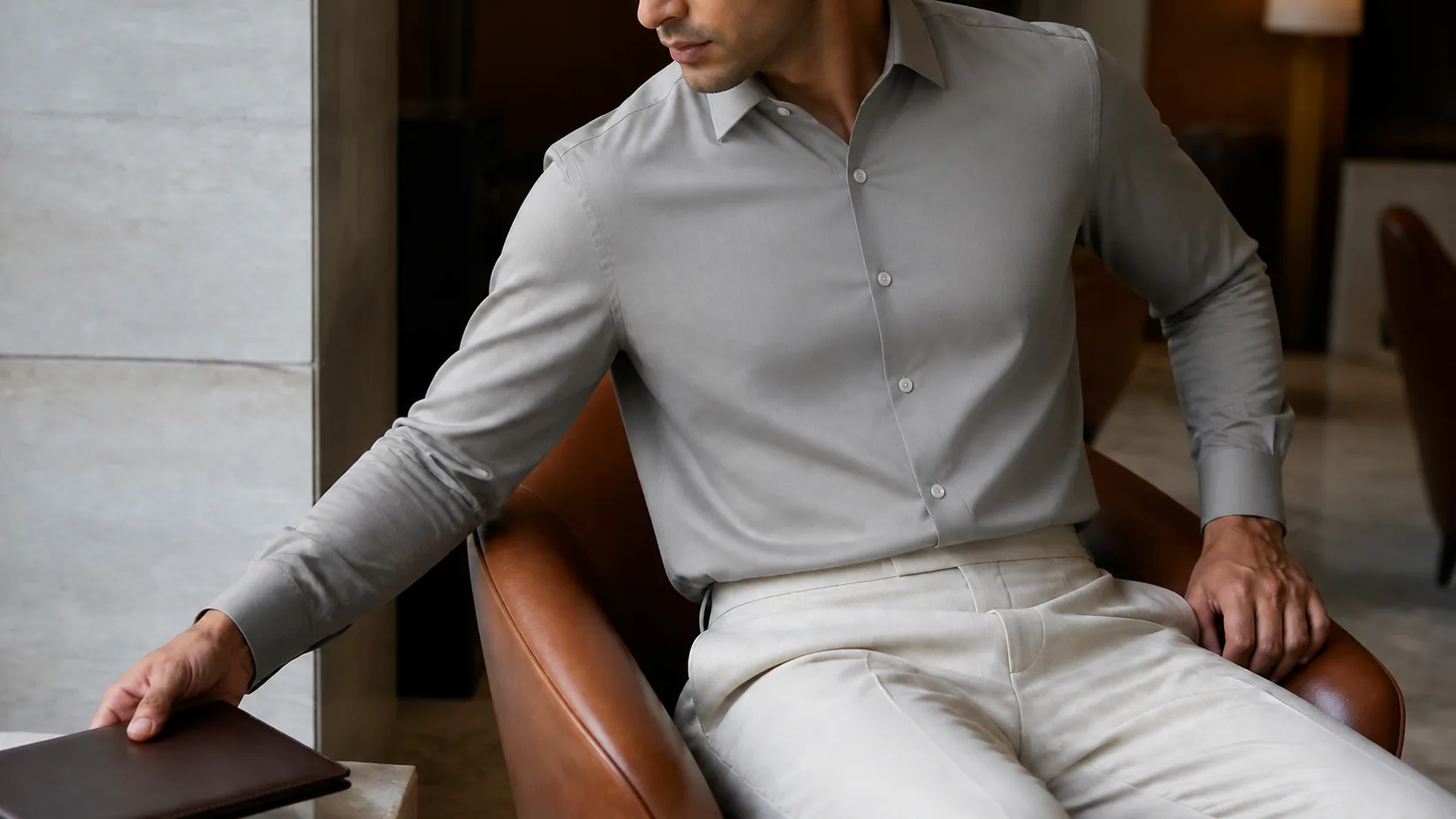
02 · On wearing it
A shirt should disappear
The best shirt in a man's wardrobe is rarely the one he talks about.
It is the one he reaches for without thinking.
The one that works on a Monday morning and still feels right at dinner. The one that survives a long flight, an unexpected meeting, a late evening and the next morning without asking to be treated delicately.
We think this is an underrated quality.
Fashion often asks a garment to be noticed.
We ask a shirt to belong.
That sounds like a small distinction. It isn't.
A shirt has to negotiate with the person wearing it all day.
It sits against the neck. It moves with the shoulder. It gathers at the elbow. It meets the wrist. It spends hours tucked in, then untucked. It has to behave when the wearer is standing, sitting, reaching, driving, travelling.
A photograph cannot tell you any of this.
A hanger certainly cannot.
You learn it by making shirts.
And then making them again.
And then listening to the people who wear them.
This is why we have always believed that fit is more complicated than a number printed on a label.
A 40 is not a man.
Two men can share a chest measurement and have completely different shoulders, posture, proportions and ways of moving.
The difference between a shirt that fits and a shirt that belongs is often invisible.
That is precisely why it matters.
At RATAN, we are interested in that invisible space.
The shoulder that sits without pulling.
The sleeve that arrives at the wrist without needing to be corrected.
The collar that frames the face rather than competing with it.
The amount of room that allows a man to move without making the shirt look oversized.
These details don't announce themselves.
They simply make the wearer feel more like himself.
Perhaps that is our idea of luxury.
Not making the garment louder.
Making the person more comfortable inside it.
A good shirt shouldn't enter the room before you do.
It should disappear into the way you carry yourself.